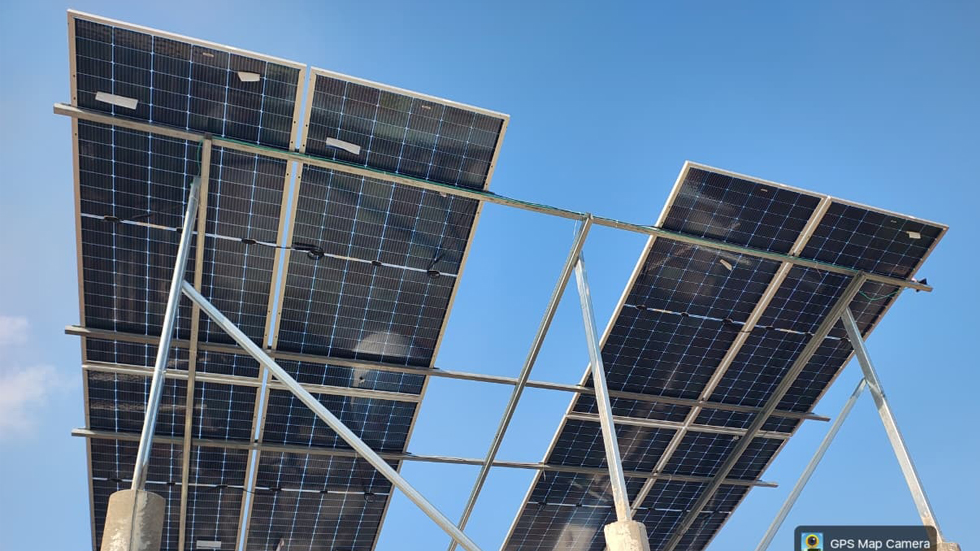
Off Grid Solar with Battery Backup
Independent power generation for remote locations or areas with frequent outages — solar plus battery storage, without dependency on the grid connection.
Solar Power Independent of the Grid
An off-grid solar system is not connected to the DISCOM network at all. Solar panels charge a battery bank through a charge controller, and the stored energy powers your loads directly through an off-grid inverter, day or night. This makes off-grid systems the right fit for locations with no reliable grid connection, remote farmhouses, outbuildings, or sites where extending a grid line would be impractical or costly. Because the battery bank must be sized to cover your full energy needs (not just a backup buffer), off-grid systems require more careful load analysis and typically cost more per kW than grid-tied alternatives.
Who is this solution suitable for?
Key Benefits
Complete Independence
No reliance on grid availability or DISCOM connection at all.
Works Anywhere
Suitable for locations far from grid infrastructure.
Reliable in Outage-Prone Areas
Power availability isn't affected by grid faults or load-shedding.
Flexible Battery Sizing
Backup duration engineered around your specific daily load.
How the System Works
- 1 Solar panels generate DC power, which a charge controller regulates to safely charge the battery bank.
- 2 The off-grid inverter draws power from the batteries (topped up by solar) to run your connected loads.
- 3 During the day, solar power runs your loads directly while simultaneously charging the batteries.
- 4 At night or during low sunlight, stored battery energy continues to power your essential and general loads.
Get a Free Site Assessment
Tell us about your property and our team will call you back.
Available System Capacity
Indicative starting points — final sizing depends on your actual consumption and rooftop or land area.
| System Capacity | Typically Suitable For | Approx. Area Required | Indicative Monthly Generation |
|---|---|---|---|
| 1 kW – 2 kW | Small cabins, single-room outbuildings | 90 – 180 sq. ft panel area | Battery sized to daily load |
| 3 kW – 5 kW | Farmhouses, small rural homes | 270 – 450 sq. ft panel area | Battery sized to daily load |
| 5 kW – 10 kW | Larger rural properties with multiple loads | 450 – 900 sq. ft panel area | Battery sized to daily load |
| 10 kW+ | Remote commercial or institutional sites | As per site survey | As per load study |
What Goes Into the System
Every installation is built from certified, compatible components sized for your load.
Solar Panels
Sized generously to ensure adequate battery charging even on lower-sun days.
Battery Bank
Lithium-ion or tubular batteries sized to your daily energy requirement.
Off-Grid Inverter
Draws power from batteries and manages charge/discharge cycles.
Charge Controller (MPPT)
Regulates power flow from panels to batteries for efficient charging.
Mounting Structure
Rooftop or ground-mount, based on the site.
Balance of System
Cabling, protection devices and a dedicated battery enclosure.
Suggested Installation Process
A clear, transparent path from enquiry to handover.
Enquiry & Load Discussion
Understand your daily appliance list and required backup hours.
Site Survey
Assess panel placement, battery location and cable routing.
Load Study & System Design
Battery and panel sizing based on your actual daily energy need.
Quotation & Approval
Transparent, itemised proposal for your review.
Installation
Panel, battery bank and inverter installation with safety checks.
Testing & Handover
Load testing, backup verification and system orientation.
What Affects Your Project Cost
- Total daily energy requirement (kWh), which drives battery bank size — the single biggest cost factor
- Battery chemistry chosen (lithium-ion vs. tubular vs. lead-acid) and its expected lifecycle
- Panel capacity needed to reliably recharge the battery bank each day
- Site accessibility, especially for remote or rural locations
- Enclosure and protection requirements for the battery bank
Estimated Savings Potential
Off-grid systems are typically justified by the value of having power at all — rather than by bill offset alone — since many off-grid sites have limited or no existing grid electricity to compare against. Where an off-grid system replaces diesel generator running costs, the fuel savings can be substantial over time.
Use our interactive calculator on the homepage for an indicative estimate based on your own electricity bill and rooftop area.
Calculate Your SavingsSubsidy Applicability
Off-grid, battery-based systems generally fall outside the standard central rooftop subsidy scheme, which is primarily designed around grid-connected, net-metered systems. Certain agricultural or irrigation-focused off-grid applications may be eligible under separate government schemes — our team can advise based on your specific use case.
View Full Subsidy GuideFinance Options
Off-grid systems can be financed through general-purpose loans or select renewable energy finance products, though approval and terms depend on the lender's assessment, since these systems don't have a grid bill to demonstrate direct offset.
Explore EMI & FinanceMaintenance Requirements
Battery health monitoring is the most important maintenance task for off-grid systems, alongside regular panel cleaning and periodic checks of the charge controller and inverter. Battery lifecycle varies significantly by chemistry and depth of discharge practices.
Solar Maintenance PlansIllustrative Project Examples
Representative examples of the scale and outcomes this solution supports.
3 kW Off-Grid Farmhouse System
3 kW / Off-Grid
A farmhouse with no nearby grid connection installed a fully independent solar-plus-battery system.
2 kW Off-Grid Field Office
2 kW / Off-Grid
A field office in an area with limited grid access used solar and battery storage for lighting and equipment.
5 kW Off-Grid Rural Home
5 kW / Off-Grid
A rural household prioritising reliability over grid dependency adopted a fully off-grid setup.
Why Choose Sarth Solar for Off Grid Solar
Careful Load Study
We size your battery bank around real daily consumption, not guesswork.
Battery Technology Guidance
Honest comparison of lithium-ion, tubular and lead-acid trade-offs.
Remote Site Experience
Installation planning accounts for site access and logistics.
Certified Installation
Safety-first practices for both panels and battery enclosures.
After-Sales Battery Support
Guidance on maintaining battery health and lifecycle.
Transparent Sizing & Pricing
Clear reasoning behind every kW and kWh in your proposal.
Related Solar Solutions
Off Grid Solar — Frequently Asked Questions
An off-grid system has no grid connection at all and relies entirely on solar plus battery. A hybrid system stays connected to the grid as a backup while also using a battery — see our Hybrid Solar page for details.
We calculate your total daily energy requirement (kWh) based on the appliances and hours you need to run, then size the battery bank with an appropriate safety margin.
Lifecycle varies by chemistry — lithium-ion batteries generally last significantly longer than lead-acid or tubular batteries, but also cost more upfront. We discuss these trade-offs during consultation.
It's possible, but ACs are energy-intensive, so the panel and battery sizing needs to account for this specifically — flag this during your load discussion.
It's technically possible but rarely cost-effective in urban areas with reliable grid access, since hybrid or on-grid systems achieve similar reliability at lower cost. Off-grid is best suited to genuinely remote sites.
The system will not be able to power all loads once the battery is depleted; this is why accurate load study during design is important to avoid under-sizing.
Yes, primarily due to the battery bank, which needs periodic health checks in addition to standard panel and inverter maintenance.
Generally, off-grid systems fall outside the standard grid-connected subsidy scheme; certain agricultural applications may have separate scheme eligibility — ask our team about your specific case.
Timelines depend on site accessibility and system size; remote locations may require additional logistics planning discussed during the site survey.
Enquire About Off Grid Solar
Fill in your details — our team typically responds within one business day.